
What Happens to a Movie Set After the Cameras Stop

A film set is built to be looked at, not lived in. It goes up fast, it holds for a few weeks of shooting, and then it comes down.
Georgia has been one of the busiest production states in the country for years, which means a lot of lumber goes up and comes back down around Atlanta every month. Most of it used to go to a landfill. The wood itself was fine. It was ordinary dimensional lumber that got cut, nailed and painted, and then it stopped being useful because the scene was over.
Lifecycle Building Center is an Atlanta nonprofit on Murphy Avenue that has spent years taking material with life left in it and getting it back into the community. For about two years now, we have donated the containers and the hauling that make part of that work possible, specifically the part involving film and television sets.
ReUse-NLT
What LBC does with that lumber is more interesting than keeping it out of a hole in the ground.
Through an initiative they call ReUse-NLT, lumber recovered from film and TV sets is collected, sorted, de-nailed, processed and remanufactured into nail-laminated timber panels. NLT is a mass timber product: boards stacked on edge and fastened together into a single solid panel, strong enough to serve as floors, roofs and walls in new construction. The technique itself is old. Building panels entirely from reclaimed film-set lumber is not.
Oak Ridge National Laboratory looked at the result. They found ReUse-NLT is 63 percent cheaper to produce and uses 70 percent less energy than a comparable panel made from virgin lumber.
That number is what moves this out of feel-good territory. A reclaimed product that costs less and takes less energy than the new version is not charity, it is a better product. The reason it has not existed at scale is that somebody has to solve the unglamorous problem of getting the material off the set and into a shop before any of the rest of it matters.
The boring part is our part
That problem happens to be our actual job.
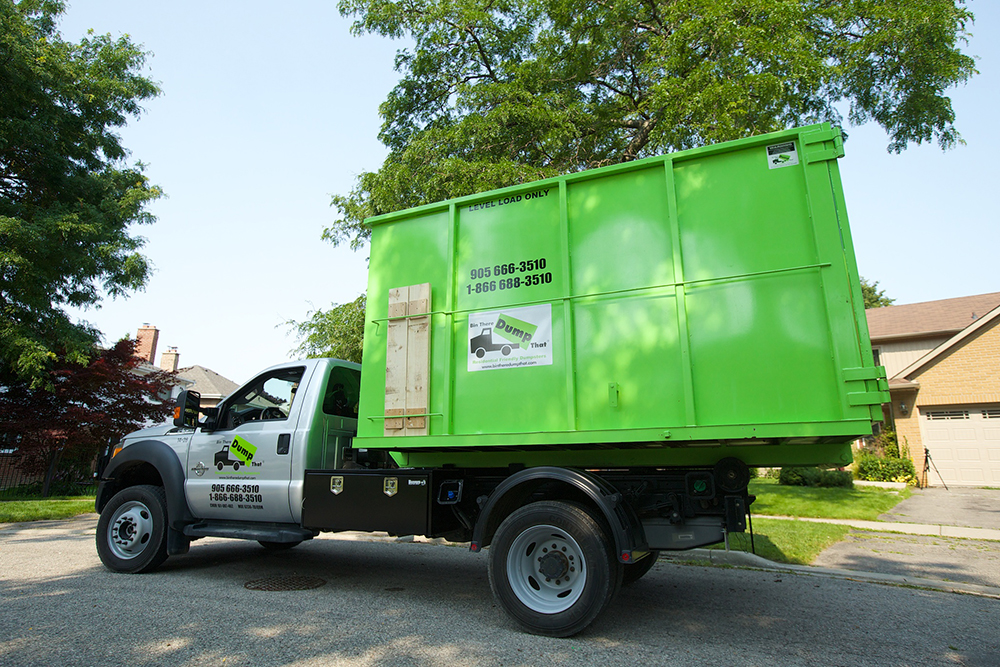
Bin There Dump That's ongoing support has been crucial to making this recovery possible, providing donated containers and hauling services that allow LBC to capture and transport materials directly from production sites rather than allowing valuable resources to enter the traditional waste stream.
Claire Kennedy, Lifecycle Building Center
One of those placements was at Electric Owl Studios, part of a broader collaboration between LBC and NBCUniversal that reaches past that one location. That particular container has since wrapped up. The relationship behind it has not.
Between the set and the finished panel there is a lot of work nobody puts in a highlight reel. Volunteers pull nails out of boards by hand. People sort lumber by length and condition. It is slow, and it is the only way the material gets clean enough to build with again.
Where it goes next
LBC is not treating this as a one-off. Organizations like the MicroLife Institute have been looking at whether ReUse-NLT could make smaller, more affordable housing possible, which is a long way from a pile of two-by-fours behind a soundstage.
For us it is simpler than that. We are in the business of taking things away. It is a better day when the things we take away do not have to be garbage.
Need a dumpster? Call 404-692-2838 or request a quote on our Atlanta dumpster rental page.